7 min read · 5 August 2026
Why You Can't Sleep After a Good Day
Exhausted but wide awake? Mental stimulation and physical tiredness are separate systems. How sound healing closes the gap and restores real sleep.
Here's the version nobody warns you about.
It wasn't a bad day. Quite the opposite. The presentation went well. A difficult conversation resolved better than expected. You solved something that had been stuck for weeks.
You were physically wrecked by 9 PM. You went to bed early, feeling virtuous about it.
And at 12:40 AM you were still awake, replaying the day at high speed, with a body that felt like lead and a mind running at full sprint.
If sleep advice has failed you, it may be because most of it assumes you're not tired enough. Your problem is the opposite. You're extremely tired and completely awake, and those two things are not contradictory, they're separate systems.
Tiredness and Sleepiness Are Not the Same Thing
This is the distinction that explains the whole problem.
Tiredness is depletion. Your muscles are fatigued, your glycogen is down, your body wants rest. It's a physical state.
Sleepiness is a nervous system state, a downshift from alertness into drowsiness, driven by accumulated sleep pressure and, critically, by the absence of activation.
You can be maximally tired and minimally sleepy. That's the "tired but wired" state, and it's the defining sleep complaint of the modern professional.
The mechanism is straightforward. Sleep onset requires the nervous system to shift from sympathetic (alert, ready) to parasympathetic (rest, digest). That shift is not something you can decide to do. It happens when the system receives sufficient evidence that nothing further is required of it.
A day full of stimulation, even positive stimulation, leaves that evidence conspicuously absent.
Why a Good Day Can Be Worse Than a Bad One
This surprises people, so let's take it seriously.
Your nervous system does not distinguish between pleasant and unpleasant activation. Excitement and anxiety produce a remarkably similar physiological profile: elevated heart rate, heightened alertness, increased cortisol and adrenaline. The subjective experience differs enormously. The physiology, much less so.
So an excellent day, a win, a breakthrough, a great conversation, a burst of creative momentum, leaves you highly activated.
Then two additional factors make it worse:
You don't try to recover from good days. After a difficult day, you might consciously decompress. After a great one, you ride the momentum straight through the evening, often working later because the flow felt good. No discharge happens at all.
The replay is rewarding. Your brain returns to the good moment repeatedly, because doing so feels pleasant. Each replay re-triggers a smaller version of the original activation. You are, in effect, dosing yourself with stimulation every few minutes while lying in a dark room trying to switch off.
This is why creative professionals and people who love their work often sleep badly. Their days are engaging, and engagement is activation.
The Second Mechanism: An Unclosed Loop
There's a further factor, particularly relevant if your day involved anything unresolved.
Your brain has a strong tendency to keep incomplete tasks active in memory. Unfinished business stays mentally accessible in a way that completed business does not. Functionally useful, it stops you forgetting things. Deeply unhelpful at midnight.
A day where you resolved four things but left two open ends means two threads are still running when you lie down. And in the dark, with no competing input, those threads finally have your undivided attention.
Notice what this means: the racing mind at 1 AM isn't a sleep disorder. It's your brain doing exactly what it's designed to do, at the least convenient possible moment, because you never gave it a better window.
Why the Usual Fixes Underperform
Sleep hygiene rules. Consistent bedtime, cool dark room, no screens. Useful, and entirely about conditions. None of them address an activated nervous system. You can follow every rule perfectly in a perfect room and still lie awake, because the room was never the variable.
Blue light glasses. Reasonable for circadian signalling. Irrelevant to activation. The problem with your phone at 10 PM is much less the wavelength and much more that you're reading something stimulating.
Trying harder to sleep. Actively counterproductive. Effort is activation. Every minute spent trying to fall asleep moves you further from the state that produces sleep. This is the cruellest loop in the whole problem.
Alcohol. Sedating, and destructive to sleep architecture, particularly REM. You'll fall asleep faster and wake at 3 AM more reliably.
Melatonin. Primarily a circadian timing signal, not a sedative. Useful for jet lag or shifted schedules. Not designed for, and largely unhelpful against, an activated nervous system.
The pattern: nearly every mainstream sleep intervention targets timing or environment. Almost none target state which is the actual problem.
Why Sound Works Where These Don't
A sound practice targets state directly, through four mechanisms:
1. It lengthens the exhale. Sustained tones naturally draw the breath into a longer, slower rhythm without any instruction to breathe differently. Extended exhalation stimulates the vagus nerve, which is the primary pathway of the parasympathetic system. This is the physiological downshift that sleep onset requires, delivered without effort, which matters enormously given that effort is the problem.
2. It occupies the replay channel. Your mental replay is auditory-verbal in character. Resonant tones take up that same attentional bandwidth. Not through argument, through occupancy. The replay loses its stage.
3. It closes the loop. A sound session gives the day's unresolved material somewhere to settle. This is why people often feel a subtle sense of completion afterward, the open threads have been given a window that isn't 1 AM.
4. It removes the effort. This is the quiet genius of it. You cannot try to fall asleep, but you can listen to sound. Listening is passive, produces no failure state, and moves you toward the exact physiological condition sleep requires. You've replaced an effortful task with a passive one that does the same job better.
The Sleep Protocol
The evening downshift: 10 minutes, around 8 PM
Not at bedtime. This is the step most people get wrong.
The nervous system doesn't downshift instantly; it takes time. Beginning your wind-down when you get into bed is like starting to brake at the junction. Ten minutes of sound at 8 PM starts the descent early enough for it to actually complete.
Close the open threads: 3 minutes
Before bed, write down everything unresolved. Not to solve. To externalise. Unfinished tasks held in working memory stay active; on paper, they stop. Three minutes here buys more than any supplement will.
The pre-sleep session: 15 minutes
In bed, lights off, headphones on. Sustained tones, no lyrics.
The instruction that matters: you are not trying to fall asleep. You are listening. If you drift off, fine. If you don't, you've still downshifted. Removing the goal removes the effort, and removing the effort is the mechanism.
If you wake at 3 AM
Don't reach for the phone. Don't start solving. Put the sound back on and treat it exactly as before, listening, not trying. The 3 AM wake-up is usually cortisol crossing the waking threshold early, and the same downshift applies.
The weekly deep session: 45 to 60 minutes
Ideally live. This moves your baseline activation, which is the variable that determines how hard your nightly downshift has to work.
What to Expect
Nights one to three: you may fall asleep faster. Some people notice this immediately; don't over-read it either way.
Week one: the more common early change is quality rather than onset, waking feeling more rested even with similar hours.
Weeks two to three: the meaningful shift. Fewer 3 AM wakings, and when they happen, a faster return to sleep. This is where most people report the practice becoming clearly worthwhile.
Beyond: for many, a lower baseline activation means the nightly wind-down needs less work. Sleep gets easier because the day was less braced.
When to see a doctor: If you snore heavily, wake gasping, or feel unrefreshed regardless of hours, please get assessed for sleep apnoea, it's common, frequently undiagnosed, and no amount of sound will address it. Persistent insomnia lasting months, or sleep problems alongside low mood or loss of interest in things you enjoy, also warrant proper medical attention. Sound work sits alongside medical care, never instead of it.
The Underlying Reframe
Most sleep advice implicitly frames poor sleep as a discipline failure, you stayed up too late, you looked at your phone, you drank coffee too late.
Sometimes true. But for a great many professionals, the actual situation is this: you spent fourteen hours activating a system and zero minutes deactivating it, and then expressed surprise when it stayed on.
That's not a discipline failure. It's a missing step.
Sleep is not something you do. It's something that happens when the conditions are right, and the single most important condition is a nervous system that has been given evidence it can stand down.
Ten minutes at 8 PM. Fifteen in bed. Not trying.
That's the whole intervention. And it works precisely because it asks nothing of you at the moment when you have nothing left to give.
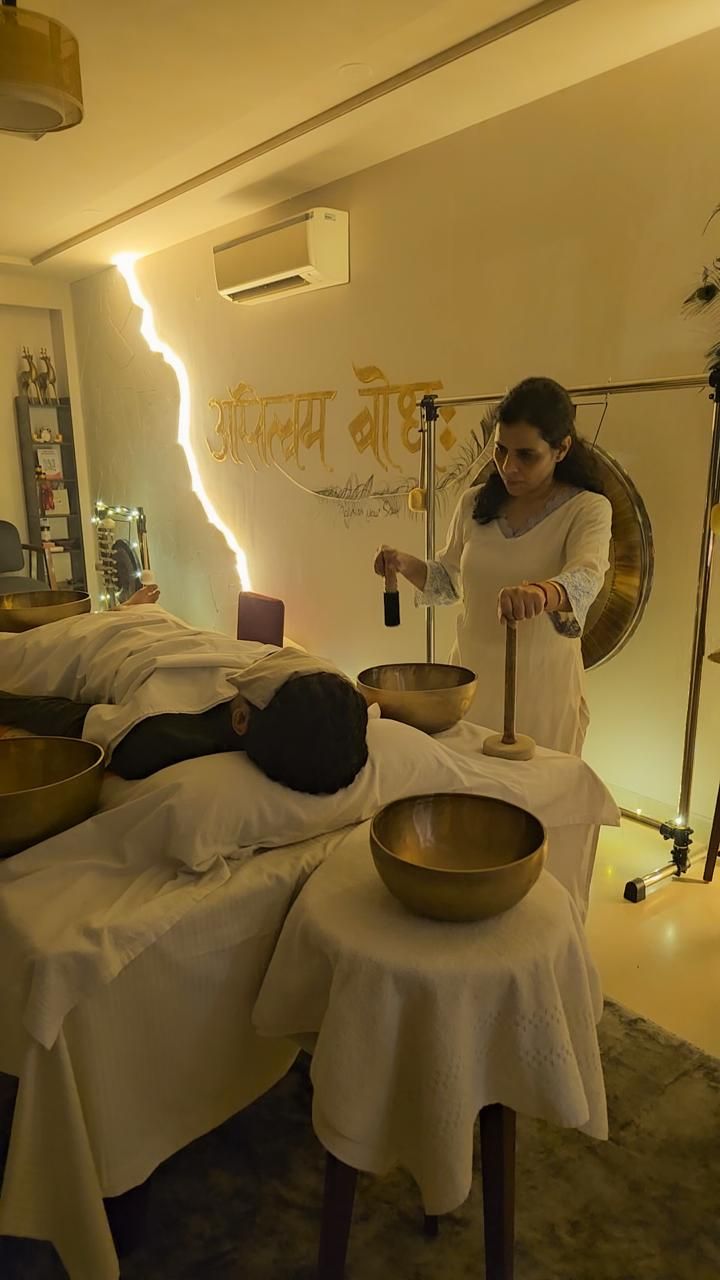
Astitv Boddh offers guided evening sound sessions and recordings designed specifically for wind-down and sleep onset.